

| |
| Home |
| Notice board |
| Download |
| The Society's history |
| Membership |
| Statutes |
| Officers |
| Journal DiG |
| Conferences |
| Excursions |
| Links |
| Site Notice |
Research Center Deutscher Sprachatlas in Marburg 2026
Geolinguistics across Borders
From 7 to 11 September 2026, the XIth Congress of the International Society for Dialectology and Geolinguistics (SIDG) was held in Marburg, Germany, under the theme “Geolinguistics across Borders.” Hosted by the Research Center Deutscher Sprachatlas at Philipps-Universität Marburg, the congress brought together scholars from more than 30 countries and provided a broad forum for current research in dialectology and geolinguistics.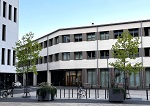
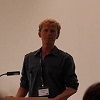
The choice of Marburg as the venue was particularly appropriate, as Prof. Dr. Alfred Lameli, Chair of the local organizing committee and director of the Research Center Deutscher Sprachatlas (photo), has highlighted in his welcome speech: The Research Center Deutscher Sprachatlas, founded in 1876, has been devoted to the study and documentation of linguistic variation for 150 years, combining the traditions of dialect research with innovative empirical and methodological approaches. As Dr. Toke Hoffmeister, Head of the local organizing committee, emphasized in his opening remarks, the setting of the congress itself reflected two central ideas that characterized the meeting: tradition and modernity, and borders and the crossing of borders.
Opening the congress in Marburg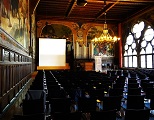
The congress officially opened on Monday, 7 September, in the historic Old Assembly Hall of Philipps-Universität Marburg (photo). In his introductory remarks, Prof. Dr. Alfred Lameli welcomed the participants on behalf of the Research Center Deutscher Sprachatlas and thanked the numerous colleagues and staff members whose work behind the scenes was essential to organizing a congress of this scale. The welcome was followed by addresses from the president of Marburg University, Prof. Dr. Thomas Nauss and the SIDG, Prof. Dr. Manuela Nevaci.
Geolinguistics across borders
The program demonstrated the breadth of contemporary dialectology and geolinguistics. Alongside the thematic sessions, parallel sections addressed topics including cognition and context, dialect and society, lexical variation, syntax, morphology, phonetics and phonology, pragmatics, the history of geolinguistics and dialectology, and the sources and infrastructures of dialect research.
A particularly strong strand concerned linguistic variation across geographical and linguistic borders. Contributions examined, among other topics, variation along the Dutch-German border, pluricentric Spanish, new dialect formation across linguistic borders, multilingual regions in Asia, Baltic language material in Georg Wenker’s atlas, and questions surrounding South Slavic linguistic borders.
These contributions illustrated that linguistic borders are not simply fixed geographical lines but they may mark differences between linguistic systems and varieties and are equally sites of contact, interaction and change. The congress therefore approached borders as dynamic spaces in which linguistic, social and historical processes intersect.
Tradition, data and digital approaches
One of the recurring themes of the congress was the relationship between the historical foundations of dialectology and new forms of data and analysis. This was particularly relevant in Marburg, where the Research Center Deutscher Sprachatlas represents a 150-year tradition of linguistic documentation and geographical research. The congress offered numerous opportunities to consider how this heritage can be connected with contemporary research practices.
Several sessions focused on the history of geolinguistics and dialectology and on established sources such as linguistic atlases, questionnaires, dictionaries and historical fieldwork. Other contributions demonstrated how these materials can be digitized, linked and reanalyzed with contemporary computational methods.
The program included presentations on the historical development of dialectology in the Baltic region, the Atlas Linguarum Europae, the Atlante Linguistico Italiano, the Slavic Linguistic Atlas, and historical dictionaries. At the same time, projects and resources such as DigitALI, corDATA, REDE SprachGIS and the Wenkerbogen-App illustrated how established collections can become part of new digital research environments.
Digital approaches were not confined to a separate methodological strand but appeared throughout the program. Contributions dealt with geolinguistic corpora, GIS-based mapping, dialectometry, quantitative analysis, automated transcription, research infrastructures and computational approaches to linguistic variation. In this respect, the congress made clear that digitalization is not a departure from the traditions of dialectology, but can provide new ways of accessing, connecting and interpreting its sources.
 Keynotes and changing perspectives
The four keynote lectures provided complementary perspectives on current developments in the field. Following Carlota de Benito Moreno’s opening lecture on variation dynamics in the western Canary Islands, Nikola Vuletić addressed “Across language and national borders: geolinguistic experiences and perspectives in Istria.”
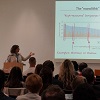
On Wednesday, Barbara Plank (photo) presented “Human-centered LLMs for Inclusive Language Technology.” Her keynote brought recent developments in computational language technology into conversation with questions of linguistic diversity and inclusion. The topic also resonated with a wider concern of the congress: how established linguistic knowledge and new technological possibilities can be combined without losing sight of the complexity of linguistic variation.
The fourth keynote, delivered by Eivind Nessa Torgersen on Thursday, was entitled “Phonetic change processes in London English: differences in terms demography or identity?” It was followed by sessions on phonetics and phonology, digital approaches to geolinguistics and dialectology, and pragmatics.
Taken together, the keynote lectures represented the broad range of approaches brought together in Marburg: geographical variation and language contact, linguistic borders, computational language technology, identity and demographic processes, and phonetic change.
Exchange beyond the lecture program
The scientific program was complemented by numerous opportunities for informal exchange. It was central to the organizers, that the conference should be more than a sequence of presentations. They hoped that the meeting would provide opportunities to cross borders not only between countries and languages, but also between disciplines, generations and research traditions, and to establish connections extending beyond the congress itself.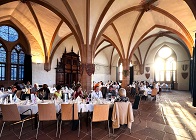
The conference structure was designed to support precisely this kind of interaction. Participants met during the daily coffee breaks and lunches, which were served in the foyer of the Research Center Deutscher Sprachatlas. The traditional German combination of Kaffee und Kuchen in the afternoons offered another informal setting for continuing discussions after the parallel sessions.
On Tuesday evening, participants gathered for the Conference Dinner in the Fürstensaal of Marburg Castle (photo). The walk from the conference venue to the castle, involving some of Marburg’s characteristic steep streets, became an additional part of the conference experience and offered another opportunity for conversation outside the lecture rooms.
On Wednesday evening, the SIDG General Meeting took place at the Research Center Deutscher Sprachatlas. The meeting provided an opportunity for members of the society to discuss matters concerning the SIDG and its future activities.
Marburg and the Research Center Deutscher Sprachatlas
The social program also provided participants with opportunities to experience the city and its academic environment. On Thursday afternoon, guided tours introduced participants to the Research Center Deutscher Sprachatlas and to Marburg from a student perspective.
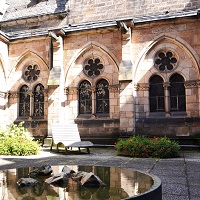 The tour of the Research Center offered an insight into the institution’s collections, research activities and history. This was especially significant in the context of the congress, as the Center was celebrating its 150-year engagement with linguistic variation and documentation. Its role as the host institution thus provided a direct connection between the history of dialectological research and the contemporary questions discussed throughout the week.
The second tour approached Marburg from a different perspective, presenting the city as a university town from the students’ point of view. Together, the two tours highlighted different dimensions of the local setting in which the congress took place.
The excursion on Friday, 11 September, brought the congress to a close. Participants travelled to Eisenach, where visits to the Wartburg and the Bachhaus connected the conference with important sites of German and Marburg cultural history: Martin Luther translated the bible to German at Wartburg from 1521 to 1522 and had a widely recognized dispute known as the Marburger Religionsgespräch (Marburg Colloquy) with Ulrich Zwingli in 1529 in the Fürstensaal (Prince’s Hall) of Marburg Castle. Moreover, the Holy Elisabeth, who is the namesake of Elisabeth church in Marburg, has lived at the Wartburg in the 13th century. The excursion provided a final opportunity for informal exchange before participants departed.
A congress shaped by crossing borders
The XIth SIDG Congress demonstrated the continuing international breadth and methodological diversity of dialectology and geolinguistics. Its program brought together research on linguistic variation across geographical and national boundaries with studies of social variation, language contact, historical documentation, computational methods and emerging language technologies.
The theme Geolinguistics across Borders proved particularly productive because it could be understood in several complementary ways. It referred to linguistic and geographical borders, but also to the boundaries between established and emerging methodologies, historical and contemporary data, analogue and digital research environments, and different scholarly traditions.
The congress therefore did not present innovation as a replacement for established approaches. Rather, as Hoffmeister emphasized in his opening remarks, crossing borders means taking existing traditions along, valuing and questioning them, developing them further, and bringing them into conversation with new approaches and research communities. This perspective was particularly fitting for a congress held at the Research Center Deutscher Sprachatlas, where a long tradition of dialectological research meets contemporary empirical and digital approaches.
The physical setting of the congress provided an apt final metaphor. In Marburg, crossing a border could sometimes mean no more than walking from one building to another: from the historic university setting to the modern research infrastructure, from established collections to new forms of analysis, and from familiar research traditions to new perspectives.
The XIth Congress concluded with a strong sense of the value of international scholarly exchange. Across five days, researchers from numerous countries and different academic traditions shared findings, discussed methods and perspectives, and established new professional connections. The congress thus reaffirmed the role of the SIDG as a forum for international cooperation and for the continued development of research on linguistic variation in all its geographical, social and historical complexity.
The organizers extend their sincere thanks to all speakers, participants, members of the SIDG, and the many colleagues whose work contributed to the success of the congress.
The XIth SIDG Congress in Marburg ended, appropriately, not with a conclusion about borders, but with an invitation to continue crossing them.
Marburg, September 2026
Dr. Toke Hoffmeister